When people think of Australia’s must-see animals, kangaroos, koalas and wombats usually come to mind.
But when visiting an Australian zoo, you will often find another native animal in the local wildlife section: the dingo.
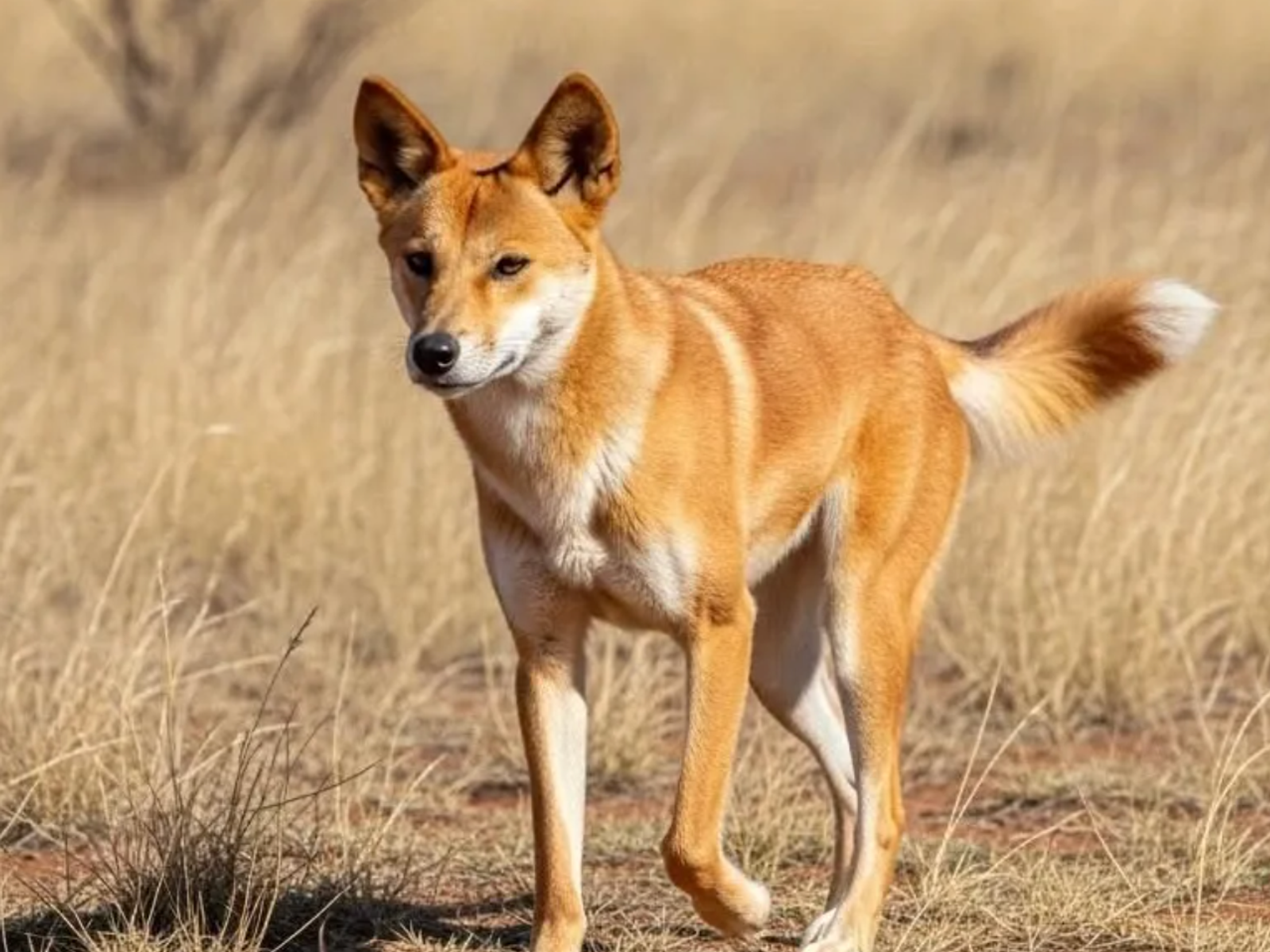
They are usually stretched lazily across a dirt mound, with golden fur, long muzzles and sharply pointed ears. They look almost identical to the yellow village dogs that once wandered through our grandparents’ courtyards in China, which makes them seem strangely familiar.
Yet when visitors approach the enclosure, zoo keepers often issue a warning: do not mistake them for gentle domestic dogs. Dingoes are wild, powerful animals.
So are dingoes descended from Chinese village dogs?
Why do Australia’s native dogs look so similar to Chinese village dogs?
Zoologists have studied this question for many years.
Several years ago, a team led by Professor Zhang Yaping from the Kunming Institute of Zoology at the Chinese Academy of Sciences worked with international researchers to compare the complete genomes of dingoes, modern domestic dogs and wolves.
They found that dingoes are most closely related to ancient dog populations from southern East Asia and Southeast Asia.
In other words, dingoes did not originally evolve as a species native to Australia.
Their ancestors came from Asia.
According to Zhang’s research, the lineage to which dingoes belong began separating from other Asian dog populations around 8,000 to 11,000 years ago. They travelled through the islands of Southeast Asia before eventually reaching the Australian continent.
Meanwhile, the ancient dogs that remained on the Asian mainland continued to mix and diverge with other dog populations that later migrated into the region.
An ancient DNA study published in 2024 by a team led by Fu Qiaomei from the Institute of Vertebrate Paleontology and Paleoanthropology at the Chinese Academy of Sciences further showed that Chinese domestic dogs experienced repeated genetic restructuring over the past several thousand years.
The Chinese village dogs we see today are therefore not direct, unchanged descendants of the ancient dog populations that lived 7,000 years ago.
Their genes carry the traces of migration, trade and human movement across thousands of years.
When the ancestors of dingoes left mainland Asia, the Chinese village dog as we understand it today had not yet taken shape.
So the relationship between dingoes and Chinese village dogs is better understood as that of long-lost distant relatives.
They share an ancient ancestor, but have evolved independently for thousands of years on two continents separated by vast distances.
How did they cross the ocean and reach Australia thousands of years ago?
For a long time, some researchers believed that these ancient dogs arrived in Australia with the ancestors of Austronesian peoples.
The ancestors of Austronesian-speaking peoples were among the greatest seafaring cultures in human history.
Beginning around 4,000 to 5,000 years ago, they expanded from areas including Taiwan into the Philippines, Indonesia, Madagascar and the many Polynesian islands scattered across the Pacific.
Today, New Zealand Māori, Native Hawaiians and Samoans are among the peoples whose languages belong to the Austronesian family.
However, research published by Zhang Yaping’s team in 2020 found that different dingo populations had already begun diverging from one another more than 8,000 years ago.
This suggests that dingoes had already spread across the Australian continent before the large-scale maritime expansion of Austronesian peoples.
Perhaps we can imagine that nearly 10,000 years ago, another episode of ocean exploration took place in human history.
A group of hunter-gatherers from southern East Asia or Southeast Asia may have left familiar coastlines in search of richer lands.
They may have travelled in simple canoes, guided only by ocean currents and the stars, accompanied by a small number of dogs.
Moving south through island chains and across narrow seas, they eventually reached Australia.
We may never know what dangers and extraordinary experiences those early travellers encountered.
But the dogs that came with them survived, reproduced and remained on the continent until the present day.
Domestication by civilisation and evolution in the wild
When dingoes are compared with modern domestic dogs, the differences become clear.
Dingoes tend to be leaner, with longer muzzles and more alert expressions.
Zhang Yaping’s research also found that dingoes retain many ancient genetic characteristics that have disappeared from modern domestic dogs.
One example involves the AMY2B gene, which plays an important role in helping dogs digest starch.
As agricultural societies developed, many domestic dogs adapted to human diets by acquiring more copies of this gene, allowing them to digest grains and starch more effectively.
Dingoes, however, do not possess the same adaptation and in this respect are more similar to wolves.
Researchers believe this may indicate that when the ancestors of dingoes left mainland Asia, large-scale agricultural societies had not yet become widespread.
During the thousands of years that followed in Australia, dingoes were shaped by natural selection in the wild.
They had to hunt for themselves and survive without depending on humans.
A 2025 genetic study led by Dr Kylie Cairns and a team of wildlife genetics and conservation researchers at the University of New South Wales argued that dingoes should not simply be classified as domestic dogs.
Nor should they be described merely as wild dogs, meaning domestic dogs that later became feral.
After approximately 8,000 to 11,000 years of isolation, without selective breeding by humans, dingoes developed their own distinct genetic structure, behaviours and ecological role.
In other words, dingoes now represent an independently evolved canine lineage.
We cannot say that one is the ancestor of the other.
But they both came from the same distant family.
It is somewhat like the human migrations that took place more than 20,000 years ago.
One group of East Asian people crossed the Bering land bridge into the Americas and became ancestors of today’s Indigenous peoples of the Americas.
Another group remained in Asia and continued adapting to life there.
Although they shared an ancient starting point, thousands of years of separation eventually produced peoples with very different languages, cultures and ways of life.
The relationship between dingoes and Chinese village dogs may be much the same.
One lineage moved closer to humans, accompanying us through countless cycles of drought and harvest, witnessing the loss of old homes and the rise of cities.
The other crossed the ocean, learning to hunt and reproduce alone in the red wilderness of Australia, watching the sun rise and fall beyond distant highlands.
Across the long river of time, they—and the humans beside them—rowed in different directions towards different shores.
The answers to their migration and evolution now lie hidden within generations of inheritance and the turning of the seasons across thousands of years.
“They share an ancient origin, but evolved independently across two continents for thousands of years.